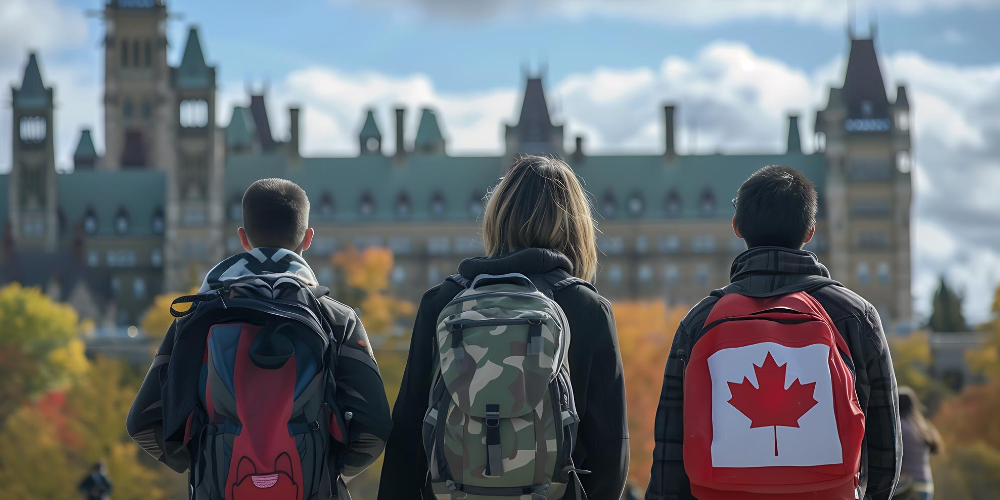





Study Permit in Surrey, Canada
Why study in Canada?
- Canadian qualifications in language education are world-class and recognized around the Globe.
- Canadian culture is more diverse and vibrant. It is considered a peaceful and safe country, which is why immigrants from all over the world come to Canada to live.
- Learning is encouraged, and different perspectives are respected.
- Tuition fees and living expenses are also in favour of Canada when compared to other countries with equally good education systems
- Students can work while studying.
Canada was a founding member of NATO, the United Nations, the Commonwealth and La Francophonie.
Economy
A Trading Nation:
Canada has always been a trading nation, and commerce remains the engine of economic growth. Canada is one of the world’s wealthiest major industrialized countries. It is a member of the G7, the G20, the Organization for Economic Co-operation and Development (OECD), the United Nations (UN), the World Trade Organization (WTO) and many other international bodies.
Canada’s economy includes three main types of industries:
Service Industry:
The service industry provides thousands of jobs across areas such as transportation, education, health care, construction, banking, and communications. retail services, tourism, and Government. More than 75% of working Canadians now work in the service industry.
Manufacturing Industries:
These industries produce products for sale in Canada and around the world. Manufactured products include paper, high-tech equipment, aerospace technology, automobiles, machinery, food, clothing, and many other goods. Canada’s largest international trading partner is the United States.
Natural Resources:
Industry include forestry, fishing, agriculture, mining and energy. These industries have played an important part in the country’s history and development. Today, the economies of many regions of the country still depend on developing natural resources, and a large share of Canada’s exports consists of natural resource commodities. While Canada boasts a highly educated workforce and a diversified economy, it is unusual among developed nations in the continuing importance of its natural resources sector (e.g., forestry, mining, energy)- even as it is one of the world’s most computer-literate and technologically sophisticated markets.
The Canadian Dollar is one of the most stable currencies in the world. Unless otherwise specified, all dollar figures presented throughout this course are in Canadian Dollars (CAD).
The first step to studying in Canada is to choose the province where you want to settle. After that, choose the right program that is relevant to your previous study.
Study English:
- The English for Academic Purposes Program, which develops the core English Language skills of a student. Students who need to improve their English language skills as a prerequisite for acceptance into a higher-level qualification can enroll in a second-language program.
- Students who need an ESL certificate or who need it as a prerequisite to starting a diploma program must be at least 15 years old.
Undergraduate Programs:
- Diploma 2 years duration
- Advanced Diploma 3 years duration
- Bachelor’s degree, 3 to 4 years duration
Admission Requirements:
- Completion of Secondary School Education or equivalent
- Age 17 or more
- Minimum IELTS score of 6.0 to 6.5 or TOEFL
- Minimum 60% marks in all subjects
- Specific requirements depending on the University, College and Level of study
Graduate Programs:
- Post Graduate Diploma (8 months to 1 year duration)
- Graduate Certificate (8 months to 1 year duration)
- Master’s Degree ( 1 year to 2 years duration)
Admission Requirements:
- Diploma or Bachelor’s Degree
- Minimum IELTS Score of 6.5. No band less than 6.0 in any module (TOEFL is also accepted)
- Minimum 65% marks
Cost of Study
Canada is among the most affordable of the top study abroad nations for international students, depending on the program and institution. It has lower tuition for foreign students than Australia, Singapore, the United Kingdom, Hong Kong and the United States of America (USA). Students can pursue their studies in a universally recognized program at one of Canada’s eminent institutions for much less than what it would cost to attend an equally reputable program at a private university or college in other countries.
In addition to having relatively low tuition fees, international students in Canada can often offset the costs of studying by working on- or off-campus (legally, up to 20 hours per week) or by completing co-op placements during their studies.
Approximate yearly cost of full-time tuition in Canada for international students (CAD $):
- Language: $15,400 (based on 44 weeks per year, $350/week average)
- College: $7,000 to $30,000, depending on institution and field of study
- University: $9,000 to $50,000+ depending on level and field of study (Statistics Canada)
The cost of studying in Canada will depend heavily on the program, institution, and level of study. Living costs, insurance, and textbooks should be considered as separate expenses and are rarely included in tuition.
Scholarships:
There are many programs and funding options for international students interested in studying in Canada, particularly for high-achieving students or, in some cases, for qualified students from certain areas or countries for whom scholarships or other financial assistance are available.
Visit the Canadian Government’s international scholarships website or the Canadian Provinces website for available Scholarships. You can explore available scholarships based on your country of origin.
Some Institutions are also offering scholarships. You may be eligible for different scholarships offered by institutions.
Residences/ Homestay/ Off-campus Housing:
Residence/ Dormitory:
Many post-secondary institutions have accommodation conveniently located on or near campus. Dorms generally have shared kitchens, bathrooms, and laundry facilities. Some dorm accommodations offer optional cafeteria meal plans where students, having paid a set price up-front, can get two or three meals per day. Best of social atmosphere & convenience in location. Apply as soon as possible.
Homestay Family:
Homestay refers to an international student living with a local Canadian family while studying in Canada. This is often one of the most memorable aspects of an international student’s experience. Alternatively, he/she may live in a dormitory with other students, which is more common with private schools. The cost of a homestay will vary in accordance with the cost of living in the region. Best experience the local culture, practicing English and receiving support. Apply in advance.
Private Accommodation/ Off-campus Housing:
You can find a list of private off-campus accommodations for rent near your institution, which is often available at the housing office or the student union office on campus. When exploring private rental housing, you will find that price, quality, and availability vary greatly. Rent may be especially high in some cities. You should expect to pay between $450 and $ 1,500 per month, depending on the city, the area you choose to live in, and whether there are co-tenants. Best for flexibility of choice. Normally available.
Required Documents:
For admission to the school of your choice following documents are required:
- Official transcripts/marksheets/academic records from grade 10 onward that show all subjects taken and grades obtained.
- Proof of English language proficiency. Official test scores (IELTS TRF)
- First page of your valid passport (the page with your photo) and last page (Showing your address)
- Detailed recent Resume
- Application Fee
Once the student submits the required documents, Welkin Immigration Services Inc. will assist in selecting the appropriate program based on the student’s academic achievements. To apply for admission to the school of your choice, email us.
List of Colleges and Universities
- Alberta College of Art + Design
- Ambrose University
- Bow Valley College
- Concordia University of Edmonton
- Lakeland College
- Lethbridge College
- MacEwan University
- Medicine Hat College
- Mount Royal University
- NAIT (Northern Alberta Institute of Technology)
- NorQuest College
- Northern Lakes College
- Red Deer College
- Rocky Mountain College
- Southern Alberta Institute of Technology (SAIT Polytechnic)
- St. Mary’s University
- University of Alberta
- University of Calgary
- University of Lethbridge
- Vanguard College
- British Columbia Institute of Technology
- Camosun College
- Capilano University
- Coast Mountain College
- College of New Caledonia
- College of the Rockies
- Douglas College
- Emily Carr University of Art and Design
- Justice Institute of British Columbia
- Kwantlen Polytechnic University
- Langara College
- Nicola Valley Institute of Technology
- North Island College
- Northern Lights College
- Okanagan College
- Royal Roads University
- Selkirk College
- Simon Fraser University (SFU)
- Thompson Rivers University
- University of British Columbia (UBC
- University of Northern British Columbia
- University of Victoria
- University of the Fraser Valley
- Vancouver Community College
- Vancouver Island University
- University of Manitoba, Winnipeg
- Assiniboine Community College
- LRSDp Arts and Technology Centre, Winnipeg
- Manitoba Institute of Trades and Technology
- Crandall University
- Mount Allison University
- St. Stephen’s University
- St. Thomas University
- University of New Brunswick
- New Brunswick Community College
- Acadia University
- Cape Breton University
- Mount Saint Vincent University
- Algoma University
- Algonquin College
- Brock University
- Cambrian College of Applied Arts and Technology
- Canadore College
- College of Business and Technology
- Carleton University
- Centennial College
- Conestoga College
- Confederation College
- Dominican University College
- Durham College
- Fanshawe College
- Fleming College
- George Brown College
- Georgian College
- Humber College
- Knox College
- Lakehead University
- Lambton College
- Mohawk College
- Niagara College Canada
- Northern College
- Sault College
- Seneca College
- Sheridan College
- St. Clair College
- St. Lawrence College
- University of Ottawa
- University of Sudbury (Laurentian University)
- University of Toronto
- University of Windsor
- Western University
- York University
- University of Prince Edward Island
- Holland College
- Quebec College
- Canada College
- CDE College
- CDI College
- College St-Michel
- Greystone College- Montreal
- Herzing College
- Insa College
- LaSalle College
- LBPSB- Pearson Electrotechnolgy Centre
- Matrix College
- Montreal College of Information Technology (MCIT)
- Bishop’s University
- University of Saskatchewan
- University of Regina
- Parkland College
- Saskatchewan Polytechnic
- Yukon University